Vienna Travel Guide for First-Time Visitors
Plan your first Vienna trip with practical advice on where to stay, getting around, food and coffee, things to do, safety, timing, and a simple itinerary.
Vienna is one of Europe’s best first-trip cities if you want beauty, museums, music, cafés, reliable transit, and a city centre that feels grand without being chaotic. The right first Vienna trip is usually **3 to 4 days**: enough time for the historic core, one or two major palaces or museums, proper coffeehouse pauses, a smarter hotel base, and a simple itinerary that does not turn every day into marble-floor endurance training.
The main mistake is treating Vienna like a checklist of imperial interiors. Hofburg, Schönbrunn, Belvedere, St. Stephen’s Cathedral, the Ringstrasse, and the Kunsthistorisches Museum all matter, but Vienna gets dull fast if you only shuffle from one gilded room to another. The city works better when you mix high culture with neighbourhood eating, trams, parks, markets, and enough dead space to sit in a café without pretending it is “wasted time.” In Vienna, sitting down is sometimes the point. Revolutionary stuff.
**Quick answer:** First-time visitors should usually stay in the Innere Stadt for maximum convenience, Neubau or the MuseumsQuartier area for culture and food, Leopoldstadt for value and Prater/river access, Wieden for a calmer elegant base near the centre, or Landstrasse if Belvedere and airport-train convenience matter. Plan 3 full days, use the U-Bahn and trams, book major museums or Schönbrunn ahead, and do not overpack palace visits.
Quick Facts
Table of Contents
- 1.Is Vienna worth visiting for first-time travelers?
- 2.Best time to visit Vienna
- 3.Where to stay in Vienna
- 4.Getting around Vienna without overplanning
- 5.Food, coffee, and how to eat well in Vienna
- 6.Best things to do on a first visit
- 7.A simple 3-day Vienna itinerary
- 8.Safety, money, and practical tips
- 9.How to time your Vienna trip for better value
Quick facts for first-time visitors
- **Best for:** museums, classical music, architecture, coffeehouses, Christmas markets, elegant city breaks, reliable public transport, low-stress first visits to Central Europe - **Less ideal for:** beach trips, wild nightlife-first weekends, ultra-cheap backpacking, travelers who hate museums or formal old-world city centres - **Best trip length:** 3 full days for the classic first visit; 4 days if you want Schönbrunn, several museums, and slower café time - **Best areas to stay:** Innere Stadt, MuseumsQuartier/Neubau, Wieden, Leopoldstadt, Landstrasse, with Mariahilf useful for shopping and value - **Getting around:** walk the historic core, use U-Bahn lines for speed, trams for Ringstrasse movement, and City Airport Train/S-Bahn/airport bus depending on budget and hotel location - **Best time to visit:** May, June, September, and early October for weather; late November and December for Christmas markets if you accept higher festive pricing - **Food reality:** classic Viennese food is worth doing, but you need to plan beyond cafés and schnitzel or the trip becomes beige with whipped cream - **First-timer mistake:** booking only for “near St. Stephen’s” and then spending half the budget to sleep beside the most tourist-shaped streets in town
Table of contents
1. Is Vienna worth visiting for first-time travelers? 2. Best time to visit Vienna 3. Where to stay in Vienna 4. Getting around Vienna without overplanning 5. Food, coffee, and how to eat well in Vienna 6. Best things to do on a first visit 7. A simple 3-day Vienna itinerary 8. Safety, money, and practical tips 9. How to time your Vienna trip for better value
Is Vienna worth visiting for first-time travelers?
Yes — Vienna is worth visiting for first-time travelers who want a polished, cultural, easy-to-navigate European capital. It is especially strong for museums, architecture, music, historic cafés, Christmas markets, and travelers who like a city that rewards planning without punishing you for imperfect planning.
Vienna is not the most spontaneous-feeling city in Europe. It is orderly, formal in places, and sometimes so well maintained that people mistake it for boring. That is unfair, but understandable if your whole itinerary is palace, palace, museum, palace, collapse. Vienna’s personality shows up when you alternate the grand stuff with neighbourhoods: Neubau for restaurants and boutiques, Leopoldstadt for the Prater and Danube Canal, Wieden for calm streets and Belvedere access, and Naschmarkt/Mariahilf for food and everyday city movement.
The city is also practical. Public transport is excellent, tap water is good, streets are generally safe, and first-time visitors can get around without a car or a PhD in train diagrams. The airport connection is easy enough, and major sights cluster in predictable zones.
The tradeoff is cost and formality. Vienna can feel expensive around the historic centre, and popular museums need timing. If you want messy nightlife, beach weather, or cheap chaos, Vienna may feel too buttoned-up. If you want a beautiful city that gives you culture without logistical nonsense, it is one of Europe’s safest bets.
> **Quick answer block:** Vienna is best for first-time visitors who want museums, architecture, coffeehouses, classical music, Christmas markets, and an easy public-transport city. It is weaker for travelers chasing beaches, bargain-basement prices, or nightlife as the whole point of the trip.
Best time to visit Vienna
The best time to visit Vienna for most first-time travelers is May, June, September, or early October. These months usually give you comfortable walking weather, outdoor cafés, gardens, and fewer extremes than high summer or deep winter.
July and August can work, but they are not automatically ideal. Some locals leave, hotel prices can still be high, and hot days make palace interiors, tram platforms, and museum-heavy pacing feel heavier than expected. If summer is your only window, build your days around morning sightseeing, shaded parks, air-conditioned museums, and evening meals outside the old core.
December is one of Vienna’s strongest seasonal moments. Christmas markets, lights, concerts, and cold-weather cafés fit the city almost too well. The catch is price and crowding: Advent weekends can be busy, central hotels get expensive, and the prettiest markets are not secret just because everyone is holding a mug shaped like evidence.
January and February are quieter and can be better value, but daylight is short and the city can feel grey unless you lean into museums, cafés, concerts, and indoor culture. April is variable but often pleasant. Late October and November are moodier, useful for lower prices but less reliable for parks and gardens.
For a first visit, spring and early fall are the easiest recommendation. December is worth it if the Christmas-market atmosphere is part of the reason you are going.
Where to stay in Vienna
The best area to stay in Vienna depends on whether you want maximum sightseeing convenience, better food and culture, calmer elegance, value, or airport/train convenience. Do not choose only by the distance to St. Stephen’s Cathedral. Vienna’s transit is good enough that the “perfect centre” is not always worth the hotel premium.
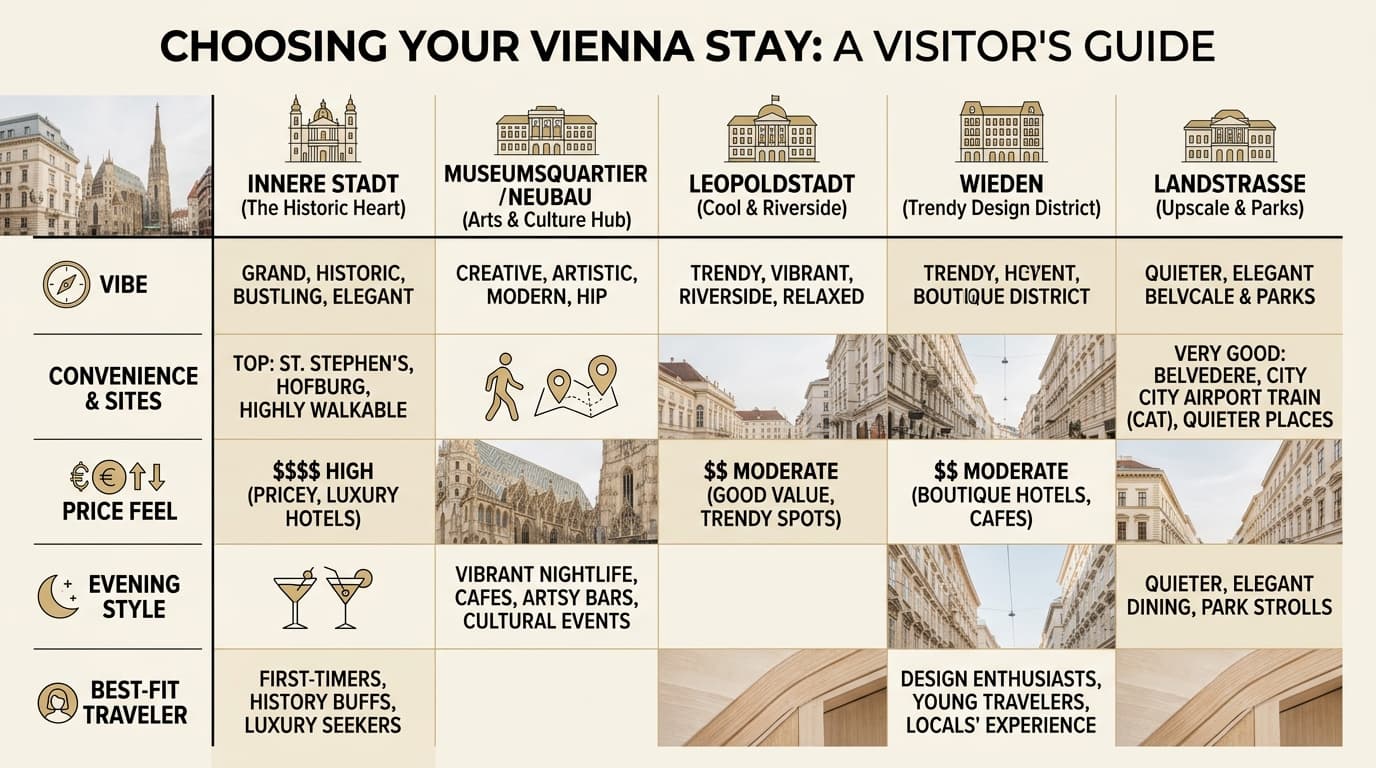
Innere Stadt / 1st District
The Innere Stadt is the easiest base for a short first visit. You can walk to St. Stephen’s Cathedral, Hofburg, the Graben, Kärntner Strasse, the State Opera, many cafés, and several museums. If you have only two nights, the convenience is real.
The downside is price and atmosphere. Some streets feel elegant; others feel like luxury retail and visitor traffic doing synchronized swimming. Stay here if convenience beats value, or if this is a special occasion and you want Vienna at your doorstep.
MuseumsQuartier, Neubau, and Spittelberg
This is one of the best first-timer bases if you want culture without sleeping in the most expensive core. You are close to the Kunsthistorisches Museum, MuseumsQuartier, Volkstheater, Mariahilfer Strasse, restaurants, bars, and smaller streets with more life after museum hours.
Neubau is a good choice for travelers who want Vienna to feel less purely imperial. It is still central, but the evenings are more useful: dinner, drinks, boutiques, and less of that “every building is judging my sneakers” energy.
Wieden / 4th District
Wieden is an excellent calmer base south of the centre. It puts you near Belvedere, Karlsplatz, the Naschmarkt edge, and good transit while feeling residential and elegant. It works well for couples, museum travelers, and people who want central access without sleeping directly in the tourist stream.
The tradeoff is that some first-time sights are a short ride or longer walk away. For most 3- or 4-day trips, that is not a problem.
Leopoldstadt / 2nd District
Leopoldstadt is useful for value, families, Prater access, Danube Canal walks, and easy links back into the centre. Areas near Schwedenplatz, Nestroyplatz, or Praterstern can be convenient depending on your plans.
It is not as classically beautiful block by block as the 1st district or Wieden, but it can be practical and better priced. Check the exact location because “2nd district” covers very different feels.
Landstrasse / 3rd District
Landstrasse is practical if you want Belvedere nearby, good transport, and easy airport links via Wien Mitte. It can be a smart base for travelers who care more about logistics than romantic old-town texture.
The area is mixed: some elegant streets, some businesslike blocks, and less evening atmosphere than Neubau. Choose it for convenience, not because it is Vienna’s most charming neighbourhood.
Mariahilf
Mariahilf works for shopping, restaurants, and value near Mariahilfer Strasse and the Naschmarkt side. It is less postcard-pretty than the old centre, but useful if you want central access with more everyday city life.
> **Quick answer block:** Stay in the Innere Stadt for convenience, Neubau/MuseumsQuartier for culture and better evenings, Wieden for calm elegance, Leopoldstadt for value and family-friendly access, and Landstrasse for Belvedere plus airport/train convenience.
Getting around Vienna without overplanning
Vienna is easy to get around without a car. The best strategy is to walk inside the historic core, use the U-Bahn for longer hops, and use trams when the route itself helps you understand the city.
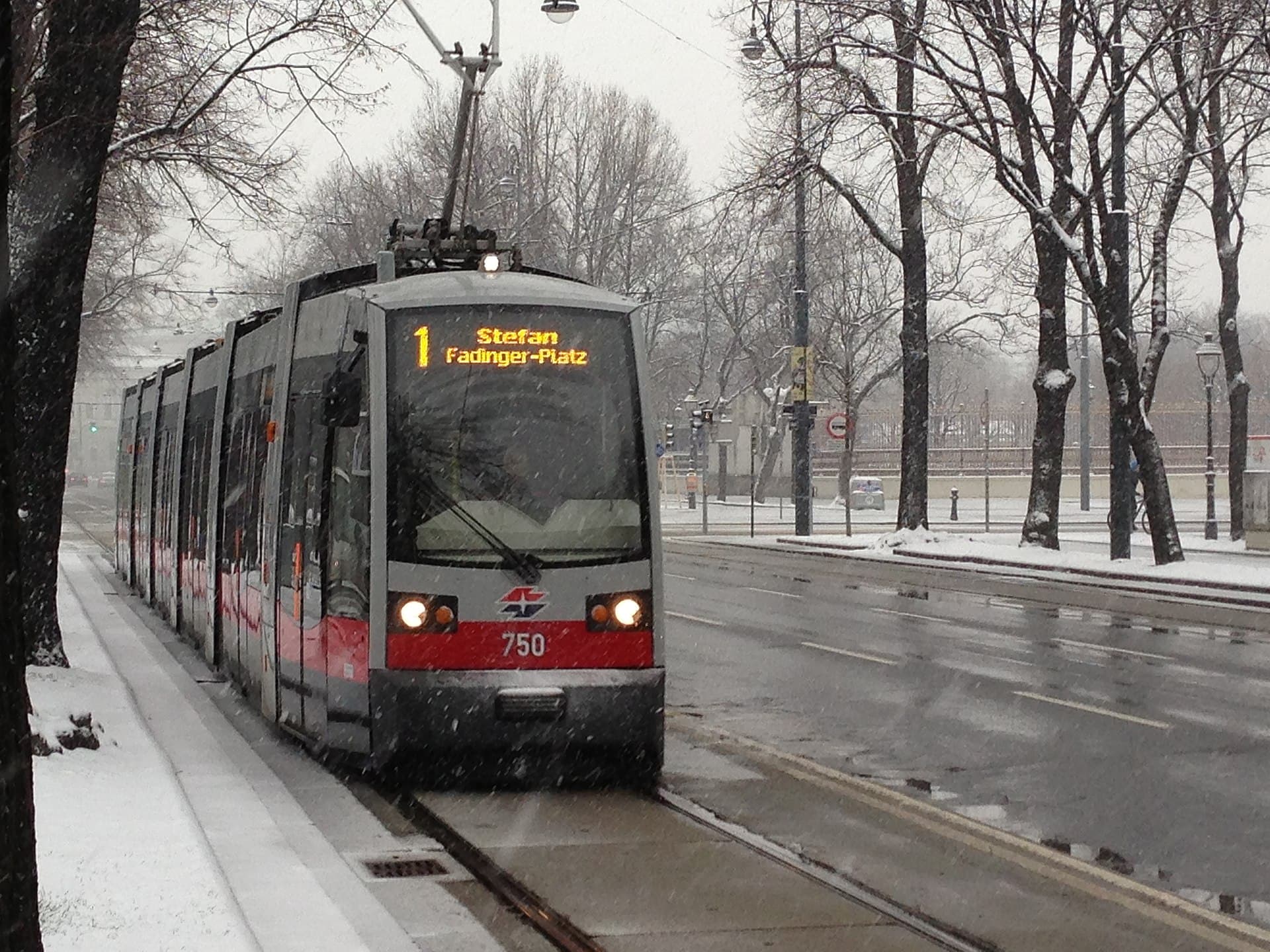
The **U-Bahn** is fast and simple. U1, U2, U3, U4, and U6 cover most visitor needs, though occasional works or line changes can affect routes, so check live routing before locking in a hotel based on one station.
The **trams** are especially useful around the Ringstrasse, Belvedere, outer neighbourhoods, and sightseeing routes where surface movement helps orient you. Trams are not just transport; they are a moving map of how Vienna is arranged.
Walking is enjoyable in the 1st district and around museum clusters, but Vienna is larger than it looks when every building is the size of a minor government. Do not walk from Schönbrunn to the old centre because a map made it look psychologically close. That is how feet file complaints.
For the airport, you have several choices. The **City Airport Train** is fast and direct to Wien Mitte but costs more. The **S-Bahn S7** is cheaper and still practical for many travelers. Airport buses can work depending on your hotel location. Taxis or ride-hailing make sense for late arrivals, heavy luggage, or groups.
Transit tickets are time-based and easy to use. A 24-, 48-, or 72-hour pass often makes sense for first-time visitors who will be moving around frequently. Validate or activate correctly, and do not assume being a confused tourist is a valid fare category. Inspectors have heard that musical number before.
Food, coffee, and how to eat well in Vienna
The best Vienna food plan mixes one classic coffeehouse, one proper Austrian meal, one market or neighbourhood meal, and a few lighter stops. If every meal is schnitzel, cake, and coffee, you have not planned a trip; you have created a museum of digestion.
Do the classics, but choose them intentionally. **Wiener schnitzel**, **Tafelspitz**, **goulash**, **Kaiserschmarrn**, **Sachertorte**, **Apfelstrudel**, and local wine tavern food are all worth trying. The issue is not the food. The issue is eating the most obvious version of it beside the busiest landmark and then wondering why Vienna tastes like laminated menu.
Coffeehouses matter. Café Central, Café Sperl, Café Prückel, Demel, Sacher, Hawelka, and others all have their fans and tradeoffs. Famous cafés can involve lines and tourist density, but at least one classic coffeehouse stop belongs in a first Vienna trip. Go at an off-hour if you can. Treat it as a pause, not a drive-by pastry extraction.
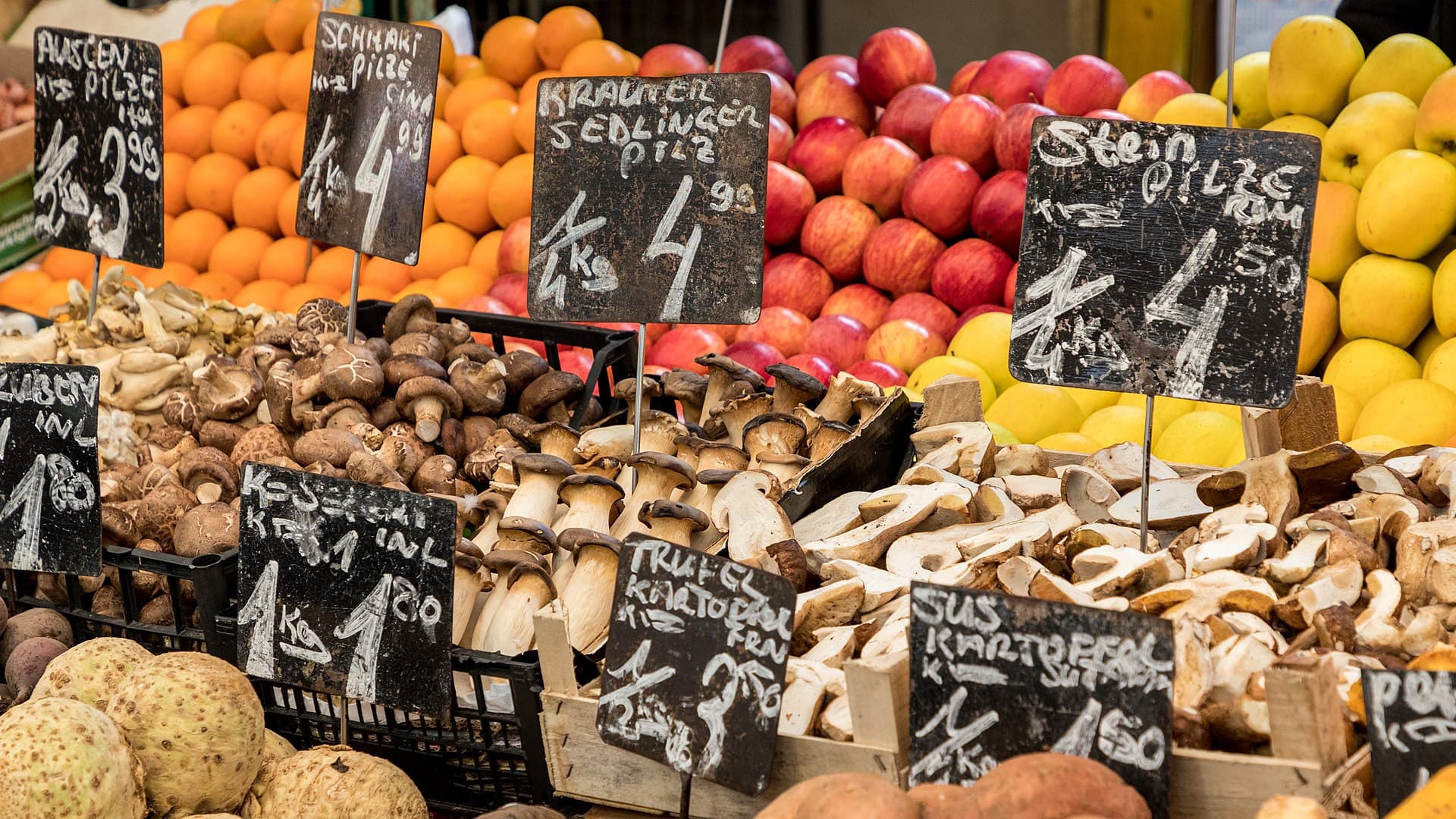
Naschmarkt is useful but not magic. It works best for browsing, snacks, casual meals, and market texture. It is not where every local secretly eats all meals in cinematic lighting. Use it as part of a Wieden/Mariahilf/Neubau day rather than making a pilgrimage across town just because the guidebook got excited.
For better everyday meals, look around Neubau, Wieden, Margareten, Leopoldstadt, and neighbourhood streets outside the most polished tourist corridors. Vienna also has strong wine culture; if the season and schedule fit, a Heuriger on the city edge can be more memorable than one more central restaurant with chandeliers and emotional prices.
> **Quick answer block:** In Vienna, plan one classic coffeehouse, one proper Austrian meal, one market or neighbourhood meal, and at least one lighter modern dinner. The best food days usually happen when you leave the immediate Cathedral/Hofburg orbit.
Best things to do on a first visit
The best first Vienna itinerary combines the historic centre, one palace experience, one or two major museums, coffeehouse time, and at least one neighbourhood outside the most formal core. Do not try to do every museum and palace. Vienna will win. It has more rooms than you have soul.
**St. Stephen’s Cathedral and the old centre** are the natural starting point. Walk the Graben, Kohlmarkt, Hofburg approaches, and nearby streets, but do not spend the whole trip circling the same luxury-shopping lanes.
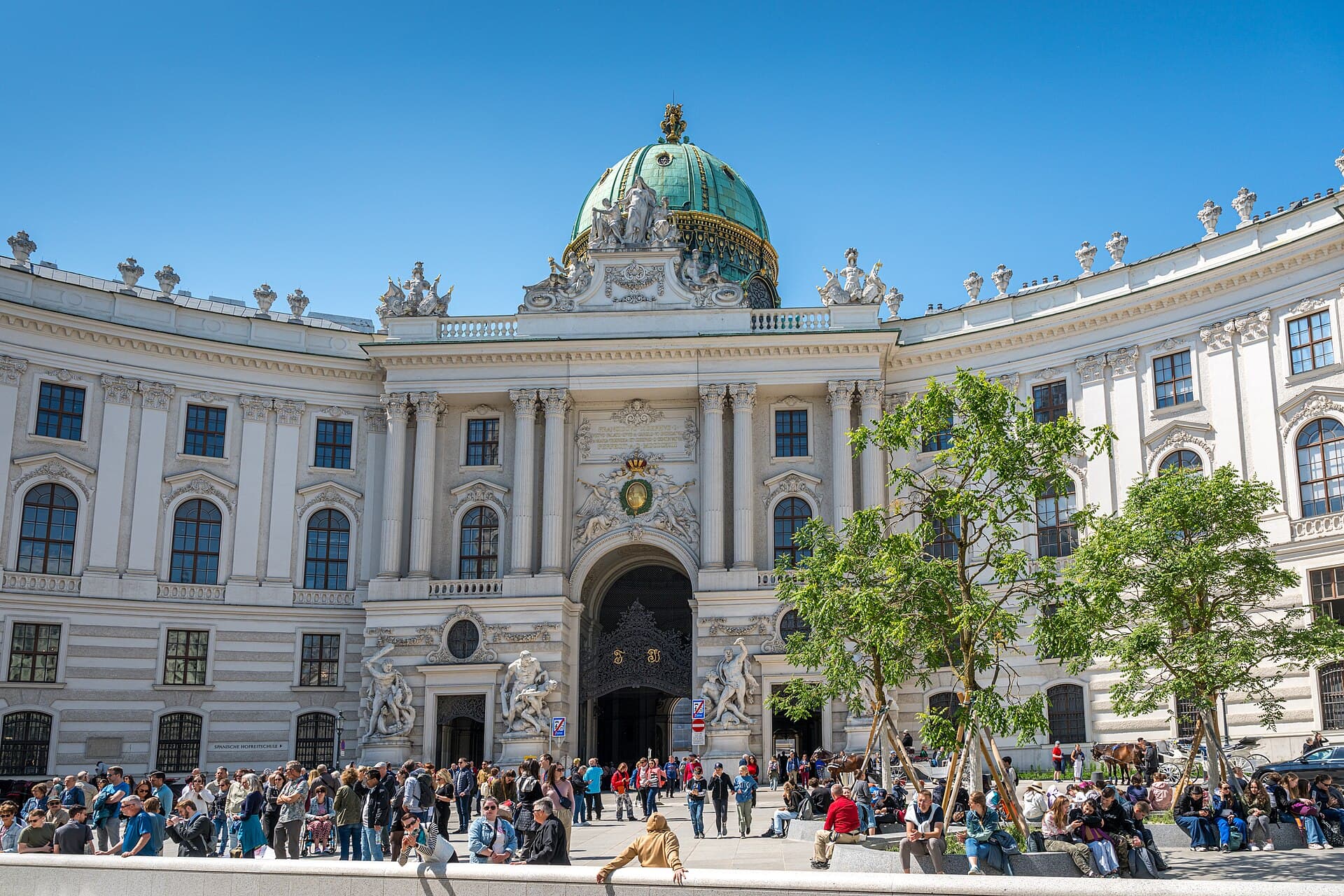
**Hofburg** is essential for understanding imperial Vienna, but choose your angle. The palace complex, Spanish Riding School area, Imperial Apartments/Sisi Museum, Austrian National Library, and surrounding squares can easily become half a day. Do not stack it with Schönbrunn and Belvedere on the same day unless you collect palaces like a nervous disorder.
**Schönbrunn Palace** is the major out-of-centre palace visit. It is worthwhile, especially for gardens and scale, but it needs time and advance planning in busy periods. Go early, book tickets, and remember the gardens are part of the value.
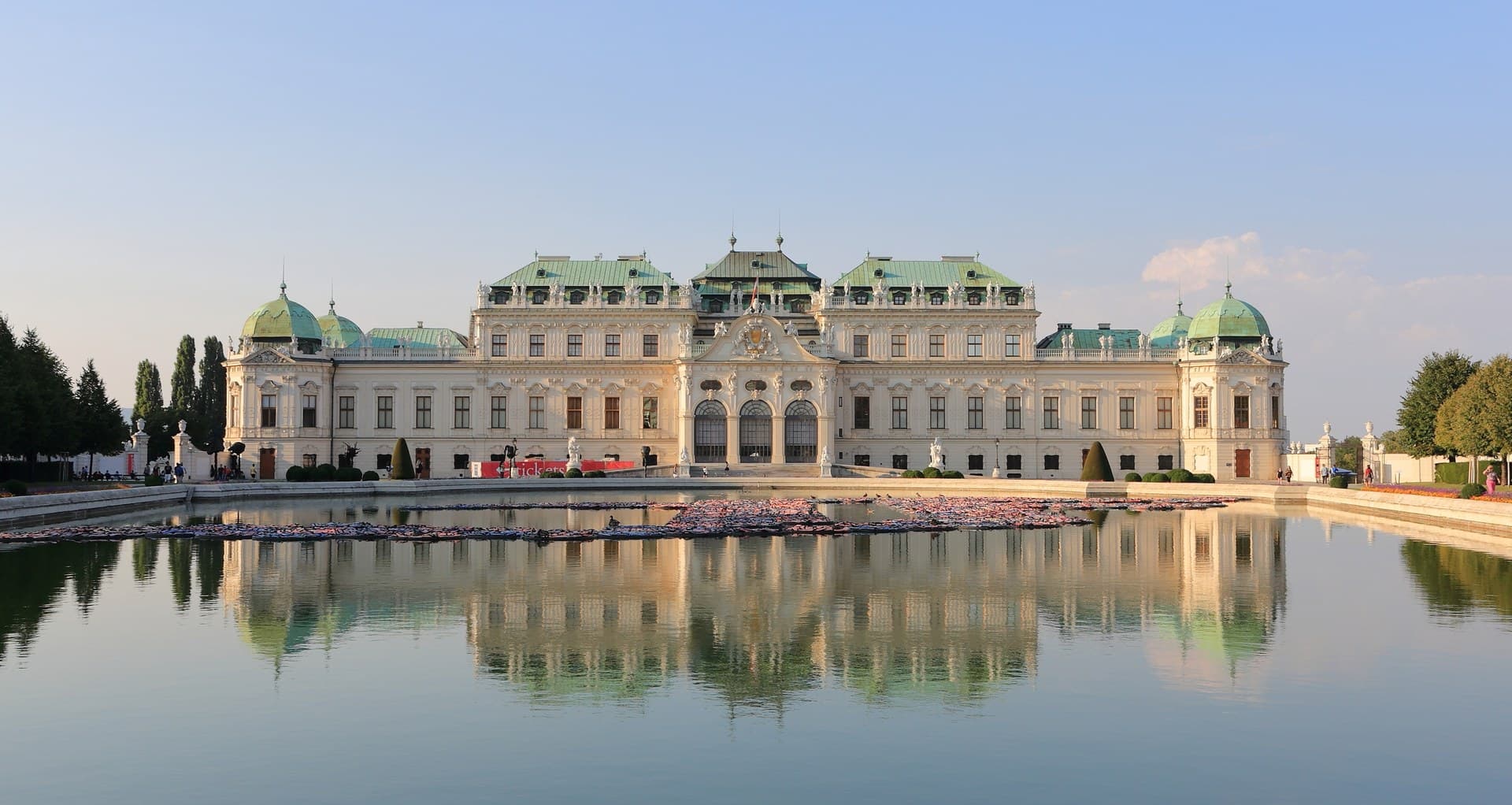
**Belvedere** is a strong first-visit choice because it combines palace setting with major art, especially Klimt’s *The Kiss*. If you are choosing between too many museums, Belvedere plus the Kunsthistorisches Museum gives a very strong Vienna art pairing.
**Kunsthistorisches Museum** is one of Europe’s great museums. Even people who normally “do not do museums” can be impressed by the building and collection. Give it proper time or skip it; half-rushing it between snacks is how great museums become expensive hallways.
**MuseumsQuartier and Neubau** help balance the old-world weight. This area is useful for modern museums, courtyards, restaurants, cafés, and a less formal evening.
**Prater** works for families, repeat visitors, or anyone who wants a change of mood. The Giant Ferris Wheel is iconic, but the bigger value is that Leopoldstadt and Prater show Vienna is not only palaces and etiquette.
**Music** can be worth planning around. A proper concert, opera, or even a tourist-friendly classical performance can fit the trip, but check venue and quality. Not every person in a powdered wig is a cultural experience; sometimes he is just a man with a sales quota.
A simple 3-day Vienna itinerary
A good 3-day Vienna itinerary should group sights by geography and energy level. Vienna punishes overstacking less brutally than Rome or Istanbul, but museum fatigue is real.
Day 1: Historic centre, Hofburg, and a coffeehouse
Start at St. Stephen’s Cathedral, then walk the Graben and Kohlmarkt toward Hofburg. Spend late morning and early afternoon around the Hofburg complex: choose the Imperial Apartments/Sisi Museum, Austrian National Library, Spanish Riding School area, or simply the courtyards and exterior route depending on your interests.
After lunch, loop toward the State Opera, Albertina area, and Ringstrasse. Build in one proper coffeehouse stop. For dinner, leave the most obvious centre if you care about value; Neubau, Wieden, or a quieter Innere Stadt edge will usually treat you better.
Day 2: Schönbrunn and MuseumsQuartier/Neubau
Use the morning for Schönbrunn Palace and gardens. Book ahead in busy periods and resist the urge to bolt straight back after the interior; the gardens and Gloriette views help make the trip feel worth the transit.
In the afternoon, return toward MuseumsQuartier, Neubau, or Mariahilf. This is a good day for a less formal dinner, bars, boutiques, or a modern museum if you still have appetite for culture. If you are cooked, sit outside with a drink and call it urban research.
Day 3: Belvedere, Naschmarkt/Wieden, and one cultural anchor
Start with Belvedere, especially if Klimt is a priority. Then move toward Wieden, Karlsplatz, and Naschmarkt for lunch or browsing. In the afternoon, choose one anchor: Kunsthistorisches Museum, Albertina, Leopold Museum, Prater, or a concert/opera plan.
Keep the final evening flexible. Vienna is a good city for one last tram ride, one last café, or a slow walk past buildings that seem designed to make modern construction feel personally ashamed.
Safety, money, and practical tips
Vienna is generally very safe for first-time visitors, including solo travelers. The main risks are pickpocketing in crowded tourist areas, overpriced central restaurants, ticket mistakes on transit, and itinerary overload.
Use normal big-city habits around St. Stephen’s Cathedral, major stations, markets, crowded trams, and Christmas markets. Keep bags zipped, avoid leaving phones on outdoor tables, and be alert around very busy platforms.
Cards are widely accepted, but keep some euros for small purchases, market stalls, lockers, toilets, tips, or old-school cafés that make payment feel like a minor negotiation. ATMs attached to real banks are preferable to random high-fee machines in tourist zones.
Book popular restaurants, museums, Schönbrunn time slots, and concerts ahead if they matter to you. Vienna is organized; pretending you are above reservations is not a personality, it is how you eat dinner at 5:15 beside a souvenir rack.
Pack comfortable shoes. Vienna is cleaner and smoother than many old European cities, but you will still walk more than expected. In winter, bring proper layers. In summer, check whether your hotel has air conditioning; older buildings can be charming until the room becomes a pastry warmer.
For etiquette, Vienna can feel a bit formal. You do not need to become aristocracy, but basic politeness, quiet public-transport behaviour, and not treating cafés like laptop camping sites will help.
How to time your Vienna trip for better value
For better Vienna value, avoid peak Advent weekends, major holiday periods, and the most obvious summer dates if your schedule is flexible. The best value-to-experience balance is usually spring and early fall weekdays, especially if you book hotels before the best central and near-central options disappear.
Accommodation is often the biggest variable. If Innere Stadt prices are silly, do not automatically downgrade to a mediocre central room. Look at Neubau, Wieden, Leopoldstadt, Landstrasse, or Mariahilf near useful transit. In Vienna, a five-minute U-Bahn ride can save real money without making the trip feel inconvenient.
Flights can work well as part of a Central Europe route. Vienna pairs naturally with Prague, Budapest, Bratislava, Salzburg, Munich, or the Austrian rail network. If direct flights are expensive, open-jaw routing through another city can make sense, especially for a longer Europe trip.
Book earlier for May, June, September, October, and December. For January, February, and some midweek shoulder dates, you may find better hotel value, but daylight and weather are the tradeoff.
> **Quick answer block:** For the best mix of Vienna weather, crowds, and value, look at May, June, September, early October, and non-weekend shoulder periods. December is worth it for Christmas markets, but book early and expect festive pricing.
FAQ
How many days do you need in Vienna for a first visit?
Most first-time visitors need 3 full days in Vienna. Two days can cover the old centre and one major museum or palace if you stay central, while 4 days gives you time for Schönbrunn, Belvedere, multiple museums, cafés, and a less rushed neighbourhood day.
What is the best area to stay in Vienna for first-timers?
The Innere Stadt is best for pure convenience. Neubau/MuseumsQuartier is best for culture, restaurants, and a less formal evening scene. Wieden is best for calm elegance, Leopoldstadt for value and Prater access, and Landstrasse for Belvedere plus airport-train convenience.
Is Vienna expensive?
Vienna is not cheap, especially around the historic centre and during Christmas-market season. It can still be good value compared with cities like Paris or London if you stay just outside the 1st district, use public transport, and avoid eating every meal beside major sights.
Is Vienna easy to get around without a car?
Yes. Vienna is very easy without a car. The U-Bahn, trams, buses, and walking cover almost every first-visitor need. A car is unnecessary in the city and usually more trouble than it is worth.
Is Vienna safe at night?
Vienna is generally safe at night in central and well-used areas. Use normal city awareness around stations, crowded nightlife areas, and tourist zones, but most first-time visitors find the city low-stress and easy to navigate after dark.
Let Fare Window find the best fares for your next trip.
Track routes, watch price changes, and get smarter alerts before you book.
Start tracking faresKeep planning
Related travel guides
Explore more first-time destination guides while you compare routes, seasons, and trip shapes.